v1.0 Oct 25th, 2022. v1.1 July 10th, 2024. Author: Joseph Argiro, jargiro@ironkeycapital.com
Company
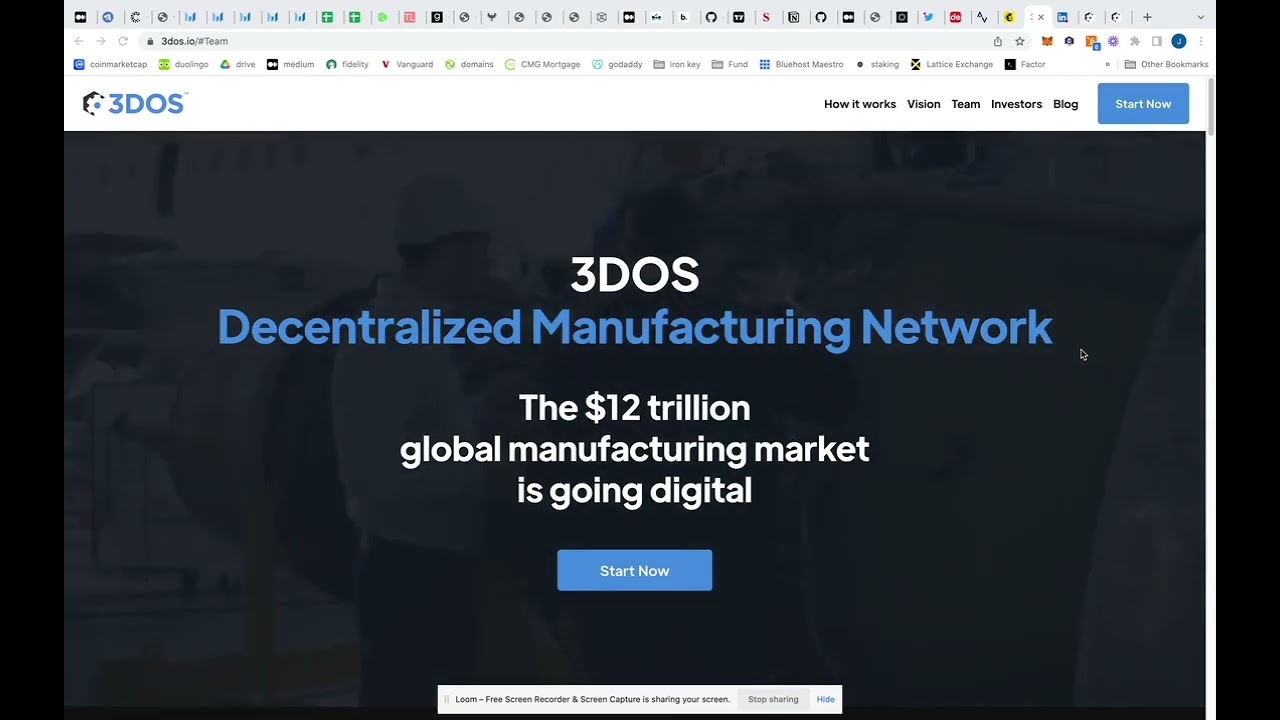
3DOS is a marketplace for designers, manufacturers, and businesses looking for a turn-key 3D printing solution. The company enables anyone to upload a design, receive royalties, and have it made anywhere in the world.
Their software platform reduces the cost to on-demand manufacture by up to 96% by providing the software layer to connect 3D printing machines to consumers and designers worldwide.
The company has signed key partnerships with Ozzy Osbourne, Global Merchandising, and manufactured.com. It will leverage its existing network of 180,000+ designers and 55,000 3D printers to bootstrap adoption.
The company is backed by notable investors and advisors including Vulcan Capital (Paul Allen), the former CEO of Docusign, the CTO of Salesforce, and a LinkedIn co-founder.
Reasons to Believe
- Real world networks and infrastructure can be built by incentivizing people with digital tokens, the proof of physical work thesis.
- The marketplace business model is now permeating physical product sectors that were previously resistant to digital transformation. The 3D printing process is fragmented, requires multiple manual touchpoints, and is ripe for disruption. There is currently no platform that lets a designer monetize 3D printing design work effortlessly, or lets a business find a 3D printer nearby and a designer to spin up a merchandising effort.
- The team has built multiple businesses in the additive manufacturing space and has an existing network of designers and 3D printers.
Risk Factors
- Traction conversion: it is unclear when 3DOS will begin to generate revenue, and there is integration risk in porting the existing network of designers onto the new platform. Onboarding designers and achieving critical mass with a three-sided marketplace is no small feat. Onboarding manufacturers appears easier given existing relationships such as StanleyX and Forecast 3D.
- GTM strategy: how are they acquiring new, outside designers and businesses to use the platform, and how will they incentivize user adoption?
Market
There are various projects attempting to connect the physical and digital worlds, a solid indication that blockchain technologies will eventually find product market fit here in some capacity. Phygi.io is one example, which allows you to turn NFTs into physical posters. There is certainly a market for this, but the opportunity is much larger. Another project with a bigger vision is the Galileo protocol, which allows for the creation of pNFTs, tokenizing real world assets. This unlocks additional demand at the margin through fractionalization.
This is great, but it still does not solve the proof of authenticity problem. The problem needs to be solved at the source of creation to enable real proof of authenticity and the fair distribution of royalties to creators and designers.
- The global on-demand manufacturing market is $12 trillion and growing at 20% per year.
- The 3D printing market size is approximately $12.6B, with the USA occupying roughly half ($6.7B).
- About 2.2 million 3D printer units shipped worldwide in 2021, with shipments expected to reach 21.5 million units by 2030. Average printer lifespan is 5 to 10 years.
- 4M operational units x 100 uses per year x $7,500 average order size = $300B in annual revenue.
- Assuming 3DOS takes 5% of the market: $15B, and at a 20% take rate that is a $3B serviceable obtainable market.
Persistent inflation continues to drive the cost to manufacture higher, and pandemic-induced supply chain inefficiencies continue to lengthen production times. Local 3D printing solutions offer an attractive alternative to businesses reliant on overseas manufacturing, and 3DOS accelerates that trend by making 3D printers more accessible and cost effective.
Go-to-Market
3DOS will penetrate the 3D printing market first, using its existing network of 3D printers, and then expand to incorporate more advanced types of additive manufacturing. It will go to market across four channels:
- Tap into the users of its existing portfolio of additive manufacturing businesses.
- Leverage 3D print merchandising partnerships with high value, high visibility, high margin products, including an exclusive two-year NFT 3D print license with the world's largest entertainment merchandise manufacturer, pilots with antefame.com and manufactured.com, and confidential negotiations with Caterpillar and HP 3D printing.
- Outbound and inside sales, leveraging the existing sales force in the US and EU.
- Brand and influencer led, with Ozzy Osbourne merchandise featuring 3DOS as exclusive partner.
Defensibility
Proprietary Technology
- 3D manufactured parts can now be proven authentic, which will drive adoption of localized manufacturing methods.
- Designers can easily monetize their work via 3DOS's proprietary NFT licensing technology.
Scarce Assets and Knowledge
- An existing database of 9M+ 3D printing designs.
- A network of 55,000 3D printers and 180,000 designers.
Once 3DOS achieves critical mass, the platform will be highly defensible given the manual touchpoints and complexity of the 3D printing value chain.
How do designers get compensated today?
- They largely don't, because there is no way to protect royalties and IP.
- The exception is highly paid employees at big manufacturing companies.
- 3DOS focuses on allowing designers to directly monetize their creations and control their IP.
How is this differentiated for a 3D printer owner?
- You can plug in a 3D printer and immediately start receiving orders.
- Manufacturers like GKN Forecast 3D run 36 HP 3D printers and spend 20 to 35% of budget minimum acquiring clients. Taking orders is old fashioned: phone calls, $20k a month on Google Ads, trade shows.
Key Competitors
All of the competitors below are publicly traded incumbents; there is very little startup competition, which makes 3DOS an acquisition target.
- 3dhubs.com, acquired for $280M by Protolabs.
- thomasnet.com, acquired for $300M by Xometry.
- rtfkt.com, acquired by NIKE for an undisclosed amount.
Funding
$8.2M raised at a $50M valuation with participation from a long list of VCs, including RedBeard Ventures, and notable angels such as Anatoly Yakovenko (Solana co-founder).
Team
The CEO and CTO are subject matter experts in additive manufacturing and have already built three businesses in this market over the last ten years. I would like to see them add a CMO and/or COO to the C-suite. The founders invented the world's first 3D printing operating system with 200k+ users, 2.8M+ parts, and 9M+ CAD designs across 120+ countries, with customers including John Deere, Google, MIT, Harvard, CalTech, Berkeley, Bosch, the British Army, the US Navy, the US Air Force, and NASA.
Conclusion
The 3DOS DePIN platform has unlocked a new market by enabling 3D printing services to be accessible globally and without friction. 3DOS enables one-click print for any brand trying to spin up a merchandising effort. This allows anyone to manufacture at any place in real time, facilitating the transition to a decentralized manufacturing economy, and creates new demand for 3D printing machines from a previously untapped demand center: consumers and brands.
3DOS connects manufacturing machines, starting with 3D printing, to a software platform that allows designers to upload and monetize their work. Businesses then drive demand because 3DOS introduces an easier and more cost effective way to spin up a merchandising side project. This reduces fixed cost overhead, drives additional demand to existing 3D printers, and enables small businesses to own printers if they choose, expanding utilization of existing hardware while increasing productivity.
We can imagine a world where existing 3D printer and hardware companies leverage the 3DOS software layer to extend their own capabilities. It is synergistic at its core for companies like HP and Stanley Black & Decker that are starved for innovation.
3DOS has begun to penetrate the market with celebrity proof of concept programs. This physical, high margin, high visibility activity should act as a bootstrap mechanism, bringing the 3DOS marketplace layer to designers, manufacturers, and brands worldwide. This could play out similarly to OpenSea, starting with a niche and then expanding, creating a massive explosion in economic activity for physical to digital blockchain use cases.
3DOS is breaking down barriers to entry for independent entrepreneurs selling physical products that traditionally would be manufactured overseas. Via on-demand manufacturing, 3DOS has the potential to leverage crypto-economic incentives to re-introduce trust into complex supply chains. 3DOS tokens act as proof of physical work in order to pay for manufacturing real goods, effectively creating new market demand for 3D printing worldwide.
Investor FAQ
Who would you consider your biggest competitor?
- Protolabs and Xometry.
- rtfkt.com, acquired by NIKE, as physical to digital market validation.
- Most competitors do not cater to the monetization and IP needs of designers.
What insight can you share on whether the market will adopt a solution like this?
- The existing portfolio of additive manufacturing software solutions experiences near 0% churn.
- That indicates sticky customer behavior once users are onboarded to the platform.
What pain point are you solving for?
Designing, manufacturing, and selling an iPhone case: today the user must find an overseas manufacturer and negotiate a deal, then ship the parts to the US only to be reshipped out to sellers on Amazon. 3DOS enables this process to occur in one click.
How does the process work today for designers, 3D printers, and manufacturers?
Engineers at companies like Stanley Black & Decker have issues submitting jobs and getting things printed internally, and iterations take a long time, slowing innovation. Taking a prototype into production is very difficult. Latency and lack of instant access kills innovation, which is why 3DPrinterOS was so successful at reducing latency inside companies and universities. With 3DOS, one click lets companies get things made on demand anywhere in the world, but that requires IP and royalty protection.
Why would they adopt this?
End of life spare parts are a big problem, and companies are looking at additive and on-demand. Companies like Global Merchandising, which produces for Ozzy Osbourne and 50 Cent, want to track royalties, and customers want to ensure a product is authentic, whether it is fan merchandise or aerospace parts.
What problem are you solving?
- Companies are plagued with inventory complexity and costs. Nike's stock dropped 9% due to inventory issues, and they are getting hit with the cost to store products that aren't selling.
- Nike is starting to sell limited run merchandise via NFTs, having acquired RTFKT for roughly $300M.
What are their incentives to remain on the platform?
- Cost, ease of use, speed, and royalty protection. 3DPrinterOS has less than 2% attrition. It is like Amazon: once your products are listed, you don't want to take them off.
- Ideally we would like to see a dollar analysis of how this makes designers more money than existing solutions.
- Every time a company produces another batch of end of life parts for equipment like Caterpillar tractors or John Deere equipment, they spend $20M to $100M to produce and warehouse those parts. It is a massive industry problem.
What do designers do today to monetize their work?
There is a massive barrier to entry; only the big players can participate. Just as before YouTube you needed millions to run a broadcast channel, today anyone can create a channel. What YouTube did for video creators, 3DOS aims to do for the material creators of the world: anyone can take a five minute CAD class and be inventing and selling the next innovative door handle or medical clamp within hours.
What do manufacturers do today?
- Industrial 3D printing is the starting method, with CNC, waterjet, and ultimately full assembly to follow.
- Manufacturers like GKN Forecast 3D run 36 HP printers and spend 20 to 35% of budget acquiring clients through phone calls, ads, and trade shows.
- The future state is machines broadcasting their capacity, parts routing to the path of least resistance, capacity load balancing automatically, and machine owners instantly making money.
What do buyers do today?
- Most people don't design; they buy something made overseas, put a sticker on it, and ship it. Injection molding plus a first batch can cost $50k to $500k minimum, and if the product doesn't sell, the entrepreneur is done.
- 3DOS smashes the barrier to entry: if it's not purchased, it's not made.
Two major use cases
- Smashing the barrier to entry for everyone. People have millions of ideas they think they can sell; 3DOS charges $10 per design, like buying a domain name. Some will work, many will not, but $10 to try an idea beats paying millions.
- For big companies, decentralizing and onshoring inventory and manufacturing. As manufacturing decentralizes, they need a way to protect royalties, and holding everything in expensive inventory for years costs far more than making it on demand. Companies must support end of life parts for years or fall victim to the counterfeit market.
If you make it easy and affordable for customers to purchase directly from you, they will. This is what iTunes proved after pulling market share from Napster: people didn't want the entire CD, just one song, easy and digital. 3DOS aims to be the Netflix of digital parts inventories.